

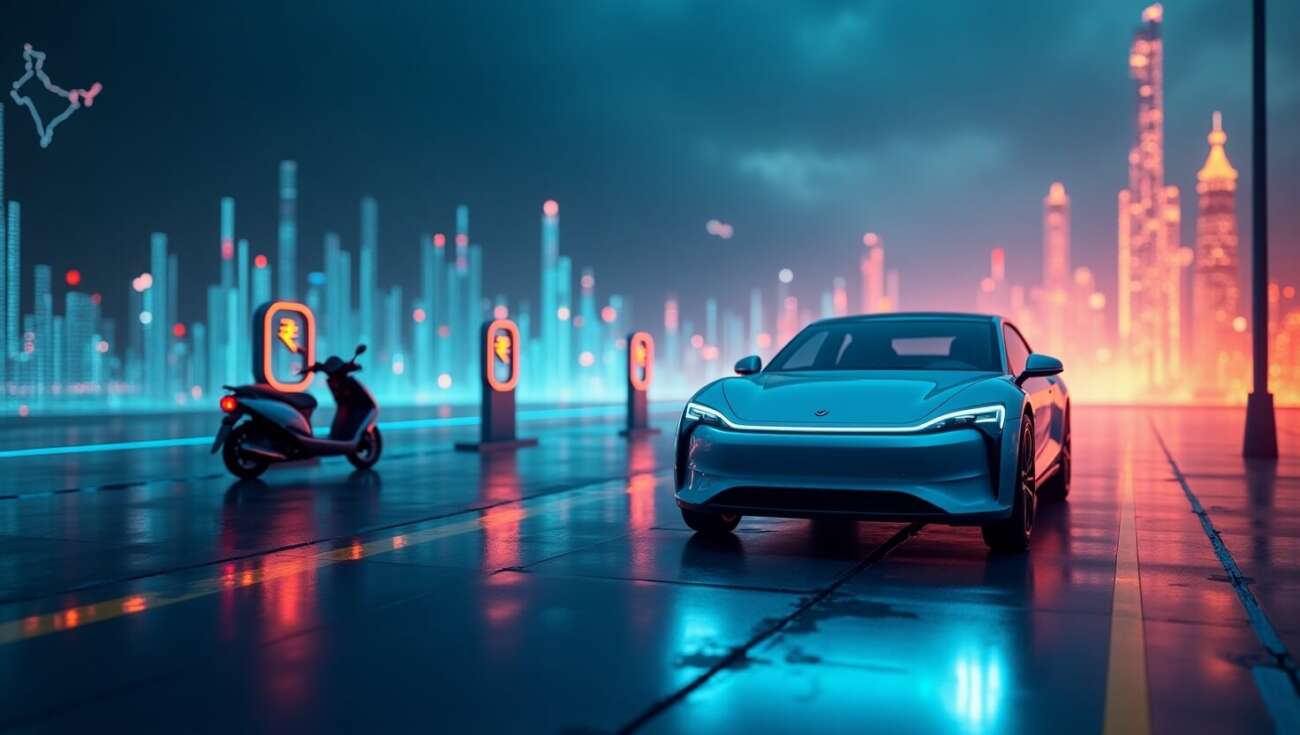
India’s electric vehicle (EV) journey is no longer about whether adoption will happen – it’s about how quickly it scales and who will lead the charge.
Passenger car EV sales are still small compared to petrol and diesel models, but two and three wheelers are already zipping ahead on adoption. Add government incentives, expanding charging infrastructure and a flood of new models, you have one of the most exciting investment themes of the decade.
But here’s the catch: not every company in the EV race will be a winner. For long-term investors, the opportunity is huge, but so are the risks. The key is to be selective and think in years, not months.
India’s EV Market: Where Things Stand
Let’s take a quick look at the current landscape:
- Market leadership is shifting. Tata Motors still holds the crown with around 35% EV car share in early 2025 but new players like JSW-MG are closing the gap fast.
- Government is all in. The new SPMEPCI scheme (2024/25) is designed to attract global EV makers to set up shop in India. This comes on top of FAME-II incentives and state-level subsidies already in play.
- Charging stations are mushrooming. Tata Power alone claims to have rolled out over 5500 public chargers and industry plans will add thousands more. Range anxiety is slowly becoming a thing of the past.
All of this tells us one thing: the EVecosystem is no longer just hype. It is turning into a real business opportunity.
How to Spot Strong EV Stocks in India
Before jumping into specific names, here are six things to look for when evaluating EV stocks:
- Which segment they play in. Two-wheelers and buses have very different adoption curves compared to cars.
- Battery access. Do they have reliable tie-ups, in house facilities or long term supply deals?
- Scale and margins. EVs need massive upfront investment, but profits only come with scale.
- Ecosystem role. Sometimes the suppliers-charging, components, power electronics-make steadier bets than the flashy car brands.
- Policy impact. Subsidies, import duties and localisation norms can make or break profitability.
- Financial strength. Companies need patient capital to ride out this capex-heavy phase.
Best EV Stocks in India (2025)
Here’s a mix of automakers (OEMs) and picks-and-shovels players like battery makers, charging firms and component suppliers. This blend helps balance risk and reward.
1. Tata Motors (NSE: TATAMOTORS)
- Why it stands out: Market leader with models like Nexon EV and Punch EV, plus strong group synergies (Tata Chemicals, Tata Power).
- What to watch: High capex and margin pressures in mass-market EVs.
2. Mahindra & Mahindra (NSE: M&M)
- Why it stands out: Aggressive roadmap for electric SUVs on new platforms, leveraging its SUV brand strength.
- What to watch: Execution speed and disciplined spending.
3. TVS Motor (NSE: TVSMOTOR)
- Why it stands out: iQube has been India’s best-selling e-scooter in several months of 2025. This shows TVS can scale EVs in a tough market.
- What to watch: Intense competition and reliance on subsidies in the 2W segment.
4. Hero MotoCorp (NSE: HEROMOTOCO)
- Why it stands out: Dual exposure with its own Vida brand and a major stake in Ather Energy.
- What to watch: Pace of Vida expansion and Ather’s performance.
5. Olectra Greentech (NSE: OLECTRA)
- Why it stands out: Strong player in electric buses with government contracts and a growing order book.
- What to watch: Tender cycles and working capital requirements.
6. Amara Raja Energy & Mobility (NSE: ARE&M)
- Why it stands out: Moving beyond lead acid batteries to set up a Li-ion cell facility and R&D centre by FY26.
- What to watch: Technology risks and delays in scaling production.
7. Exide Industries (NSE: EXIDEIND)
- Why it stands out: Building a 12 GWh Li-ion giga factory in Bengaluru. One of the few listed battery cell plays in India.
- What to watch: High capital costs and long gestation before commercialization.
8. Bharat Forge (NSE: BHARATFORG)
- Why it stands out: Expanding into EV components and lightweight parts with global clients.
- What to watch: Cyclicality in auto orders and European market exposure.
9. Tata Power (NSE: TATAPOWER)
- Why it stands out: One of India’s largest EV charging networks, with 5500+ public chargers already live.
- What to watch: How quickly utilization rises and tariff/regulatory dynamics.
Wrapping It Up
India’s EV transformation is no longer a question mark. It is happening. Policies are in place, charging stations are going up and consumer adoption is rising year after year. For long-term investors this shift could be as significant as the IT boom two decades ago.
But here’s the reality: the sector is messy, capital-intensive and fiercely competitive. Betting on one company is risky. A smarter approach is to spread investments across the ecosystem: automakers, battery firms, component suppliers and charging players.
Think of it as building a portfolio that mirrors the EV value chain. Stay patient, keep an eye on fundamentals and remember the big gains here are a marathon, not a sprint.