

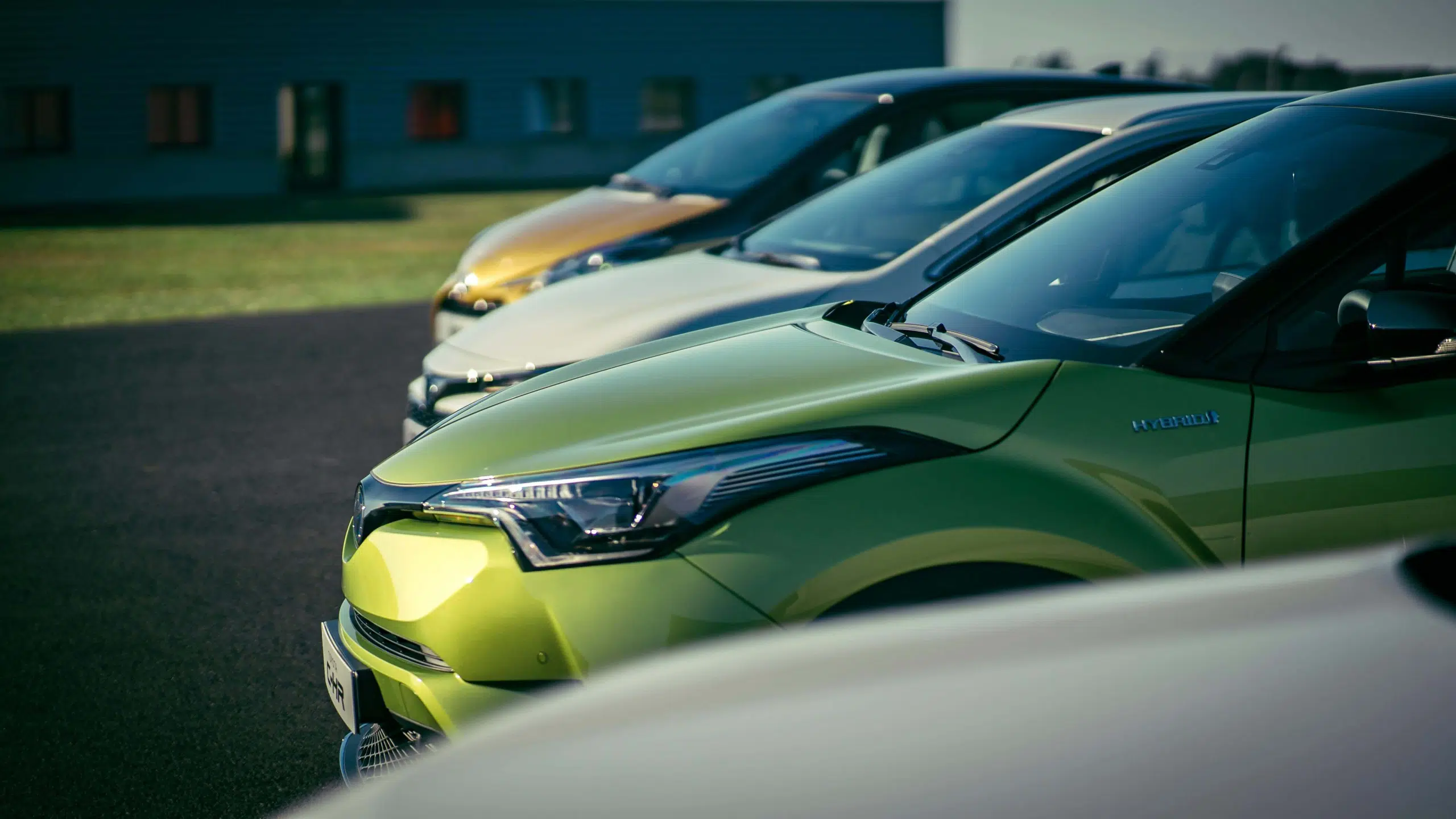
What are Electric Vehicles?
Electric Vehicles (EVs) are vehicles powered entirely or partly by electricity. Instead of an internal combustion engine (ICE) that burns fuel, EVs use electric motors powered by rechargeable batteries.
Types of Electric Vehicles
(a) Battery Electric Vehicles (BEVs) – fully electric, no fuel engine (e.g. Tesla Model 3, Nissan Leaf).
(b) Plug in Hybrid Electric Vehicles (PHEVs) – combine a battery powered electric motor with a petrol/diesel engine (e.g. Toyota Prius Plug-in).
(c) Hybrid Electric Vehicles (HEVs) – mainly petrol/diesel engine with small electric assistance; cannot be charged externally (e.g. standard Toyota Prius).
What are Hybrid Vehicles?
Hybrid vehicles use both an internal combustion engine (ICE) (petrol or diesel) and an electric motor. They combine the two systems to improve fuel efficiency and reduce emissions.
Types of Hybrids
(a) Mild Hybrid (MHEV)
- Small electric motor assists the engine.
- Cannot run on electricity alone.
- Example: Maruti Suzuki Ciaz Smart Hybrid.
(b) Full Hybrid (HEV)
- Larger electric motor and battery.
- Can run on engine, motor or both combined.
- Example: Toyota Prius, Honda City e HEV.
(c) Plug in Hybrid (PHEV)
- Larger battery charged via external power source.
- Can drive longer distances purely on electric power before switching to engine.
- Example: Mitsubishi Outlander PHEV.
What should you opt for Electric Vehicles or Hybrid vehicles?
(a) Electric Vehicles (EVs)
✅ Advantages
- Zero tailpipe emissions – fully environment friendly if charged with renewable energy.
- Lower running costs – electricity cheaper than fuel, minimal maintenance (no oil changes, fewer moving parts).
- Better performance – instant torque and smooth acceleration.
- Future-ready – aligns with government policies promoting full electrification.
❌ Disadvantages
- Range anxiety – limited range compared to hybrids, though improving.
- Charging infrastructure – still developing in many regions.
- Longer charging times – charging takes longer than refueling a petrol car.
(b) Hybrid Vehicles. Hybrids provide an effective middle ground for people seeking improved fuel efficiency and reduced emissions without fully committing to an electric vehicle.
✅ Advantages
- No range anxiety – uses fuel engine as backup, ideal for long distances.
- Better fuel efficiency than traditional petrol/diesel cars.
- Lower emissions compared to ICE vehicles.
- No dependence on charging infrastructure for HEVs (though PHEVs require charging for electric mode).
- Generally cheaper upfront than electric vehicles.
❌ Disadvantages
- Still emits pollutants – not fully emission free.
- More complex systems – combination of electric and fuel engine leads to higher maintenance than pure EVs.
- Smaller environmental benefit compared to EVs.
Which is better?
🔷 Choose an EV if:
- You mostly drive within the city.
- You have access to home or public charging.
- You want lower running costs and zero emissions.
- You are looking for long term sustainability and future policy benefits.
🔷 Choose a Hybrid if:
- You often drive long distances where charging is unavailable.
- You want better fuel efficiency but are not ready for full electric.
- You live in areas with poor charging infrastructure.
Why Electric Vehicle Stocks Are a Smart Long-Term Investment?
(a) Growing Global Demand
With rising environmental concerns and strict emission regulations worldwide, demand for electric vehicles is increasing rapidly. More countries are setting deadlines to phase out petrol and diesel cars, boosting EV adoption.
(b) Government Support and Incentives
Governments across the world offer subsidies, tax benefits and policy support to encourage EV adoption and manufacturing, creating a favourable environment for companies in this sector.
(c) Technological Advancements Continuous improvements in battery technology, charging infrastructure and manufacturing efficiency are making EVs more affordable and practical, further expanding the market.
(d) Expansion of Charging Infrastructure
Rapid development of charging networks is removing range anxiety barriers, encouraging more consumers to switch to electric vehicles.
(e) Strong Industry Growth Projections
Analysts predict exponential growth in the EV market over the next decade, with electric vehicles potentially making up a large share of new car sales by 2030.
(f) Diversified Investment Opportunities
The EV sector includes not just automakers but also battery manufacturers, charging infrastructure companies, semiconductor firms and raw material suppliers, offering a wide range of investment options.
(g) Sustainability Megatrend
Investing in EV stocks aligns with the global shift towards clean energy and sustainability, a trend likely to shape economies and policies in the long run.
(h) Competitive Innovation
Major automakers and startups are constantly innovating to capture market share, leading to technological breakthroughs that can drive stock prices higher.
In summary, investing in EV stocks positions you to benefit from a sector that is backed by strong policy support, rapid technological development and a long term shift towards cleaner transportation. It is an investment in the future of mobility and sustainability.
What does Endurance Technologies Ltd do?
Endurance Technologies Ltd is a leading Indian manufacturer of automotive components with a significant international footprint. Below is an overview of their operations:
🏭 Core Business Areas
1. Aluminium Die Casting
They are among India’s largest producers of high pressure, low pressure, and gravity die cast parts, manufacturing products such as alloy wheels and engine or transmission casings for two wheelers, three wheelers, and passenger vehicles.
2. Suspension Systems
They produce front forks, mono-shock, and twin tube shock absorbers for two and three wheelers, commanding approximately 40% market share in India.
3. Transmission Products
Their portfolio includes clutch assemblies, cork and paper friction plates, CVT systems, driveshafts, and torsional dampers, serving both two and three wheeler segments.
4. Braking Systems
They supply disc brakes, drum brakes, tandem master cylinders, and complete braking systems—including ABS—for motorcycles and scooters.
🌐 Aftermarket and EV/Hybrid Segments
- They operate a robust aftermarket business distributing replacement parts such as brakes, suspension components, and transmission systems, covering 213 districts across 34 countries.
- The company is also expanding into the electric and hybrid vehicle space, manufacturing battery pack and motor housing castings along with Battery Management System (BMS) PCBs and electronics, securing EV orders worth INR and €91 million.
Is Endurance Technologies the Next Auto Ancillary Multibagger?
Endurance Technologies has strong growth credentials, but calling it the “next auto‑ancillary multibagger” requires balancing optimism with caution. Here’s a well-rounded take:
✅ Growth & Competitive Strength
- Robust financials: FY25 consolidated revenue was ₹11,561 cr (+12.9 % YoY), PAT ₹836 cr (+22.9 %). Q2FY25 saw PAT surge ~31 % YoY.
- Margin resilience: TTM EBITDA margin ~14.4 % and standalone ~13.6 %.
- Strong ROE/ROCE: 15 -18 % range indicates efficient management.
- Asset-light, low-debt model: Net debt-to-equity ~0.17; cash-rich and low leverage.

🌱 EV Shift & Product Diversification
- Front-runner in 2W/3W components (machining, suspensions, brakes).
- EV-ready: built in capabilities in Battery Management Systems (via Maxwell Energy Systems acquisition.
- European footprint: 12 plants with strong growth (+20 – 22 % YoY) even during soft EU auto demand.
✅ Acquisition & Expansion
Endurance Overseas Srl, a subsidiary of Endurance Technologies Limited, has entered into a Share Purchase Agreement to acquire a 60% stake each in Stoferle Automotive GmbH and Stoferle GmbH in Germany.
Additionally, Endurance Technologies has increased its stake in Maxwell Energy Systems Pvt Ltd by acquiring an additional 5.5% equity from ION Energy, Inc., raising its total shareholding to 61.5%. Furthermore, Endurance Overseas Srl, Italy, a subsidiary of the Company, has acquired a 100% stake in Ingenia Automation Srl (Ingenia), Italy with effect from 31st May 2024.
📈 Valuation & Analyst Outlook
- Premium Valuation: Trades at P/E ~45–48× vs. fair P/E ~32×.
- Analyst Price Targets:
- LKP: ₹2,278 ~23 % upside from ~₹1,850 in Feb 2025.
- Simply Wall St: average 12 Month target ~₹2,603 (slightly below ₹2,665 price).
- Dalal Research sees long term potential to ₹3,200 – 4,400 by 2028-30.
⚠️ Risks & Headwinds
- Rich Valuation: A high P/E puts pressure on future returns if growth falters.
- Technical Resistance: Faces ₹2,700–2,740 resistance with mixed short term indicators.
- Margin Pressures: Integration of Maxwell & raw material costs may affect near term margins.
🧭 Final Verdict: Multibagger or Not?
- Infrastructure for growth: The company benefits from a robust franchise in its core automotive business, strategic expansion into electric vehicles, diversification into European markets and a healthy, debt free balance sheet.
- Valuation makes performance delivery critical: With the stock trading at approximately 45 times its earnings, investors are pricing in strong future growth. This elevated valuation leaves little room for disappointment, making it essential for the company to consistently deliver on its earnings expectations to justify its premium multiples.
- Multibagger potential: Over the next 3 to 5 years, if Endurance Technologies Limited sustains its earnings growth trajectory of 15–20% annually, the stock has the potential to generate returns of 2 to 3 times the current price. This would categorically qualify it as a multibagger, rewarding patient investors with significant wealth creation.
- Short-term caution: Near-term gains might remain limited until there is clear evidence of sustainable margin expansion and meaningful progress in EV scale up.
Conclusion
The electric vehicle revolution is no longer a distant dream – it is unfolding right before our eyes. As governments push for cleaner mobility, companies innovate aggressively and consumers embrace sustainable choices, EV stocks stand poised for robust long term growth. While short term volatility may test patience, visionary investors who position themselves today can benefit immensely as this transformative shift gains momentum. Investing in electric vehicle stocks isn’t just about chasing returns; it’s about participating in a global movement towards a greener, technologically advanced future. Now is the time to ride this electrifying wave of opportunity.