

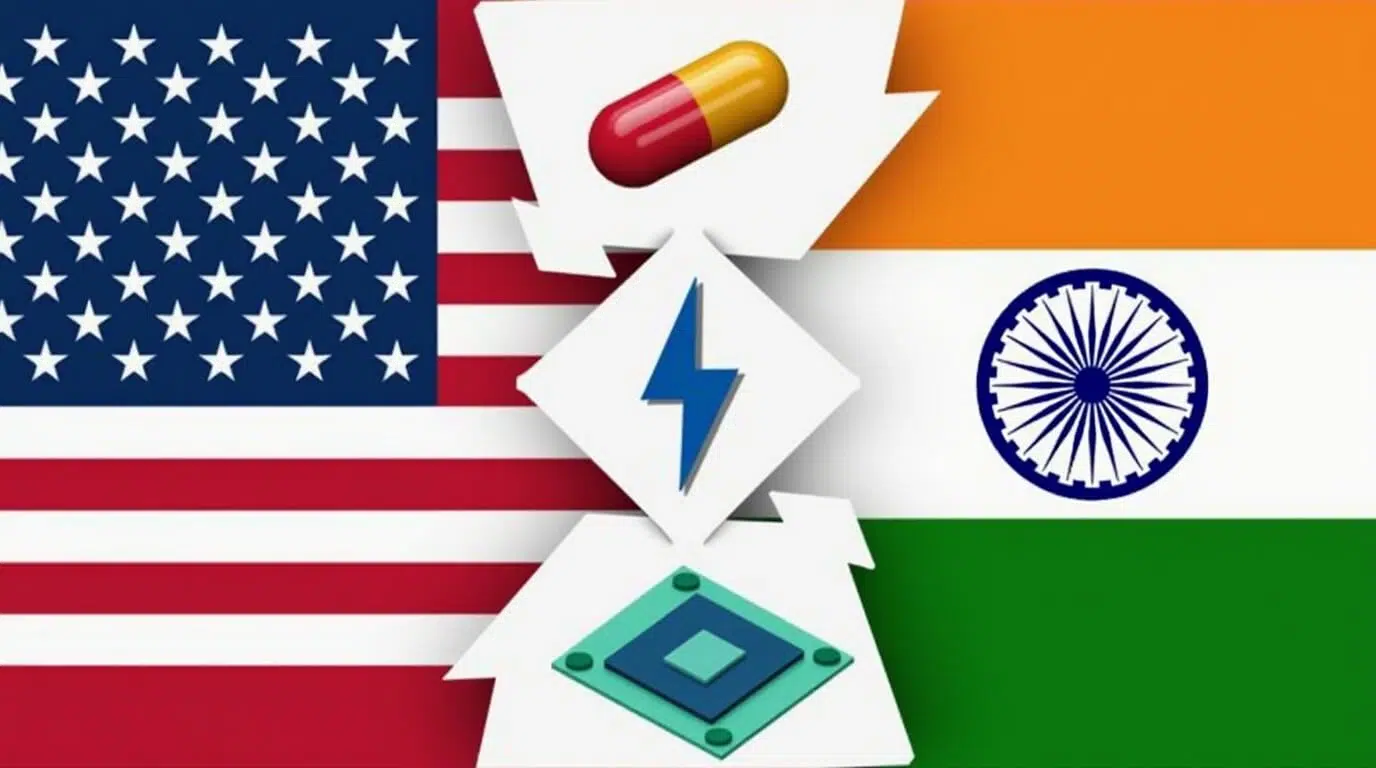
The US escalated trade tensions by imposing an additional 25% tariff on Indian goods, raising the total to 50%, effective August 27, 2025. This move impacts key export sectors, economic growth and investor sentiment, while creating new challenges and opportunities across industries and Indian stock markets.
Why has Trump announced 50% tariff on India?
Here’s why President Donald Trump has announced a 50 percent tariff on Indian goods and what it means:
Why 50% Tariffs on India?
- Response to India’s Russian Oil Purchases
Trump initially imposed a 25 percent reciprocal tariff on Indian exports. Soon after, he issued an executive order adding another 25 percent penalty, specifically tied to India’s continued purchases of Russian oil, which the U.S. frames as indirectly supporting Russia’s war machine in Ukraine. - Strategic Leverage, Not Just Trade
According to commentary and experts, these tariffs are part of a broader shift in US foreign policy using trade tools as political coercion or “national security tariffs.” This marks a move away from diplomacy toward more aggressive pressure tactics. - Concerns About Double Standards
India has criticized the move as unfair and unreasonable, pointing out that other major buyers of Russian oil (like China or the EU) haven’t faced similar penalties. Indian officials argue their energy decisions are driven by market stability and national interest – not geopolitics. - Political and Geopolitical Backdrop
Some US officials, like trade advisor Peter Navarro, have painted India’s oil strategy as fuelling Putin’s war, while others warn that sabotaging the US – India partnership hinders efforts to counterbalance China. The tariffs put India in the same punitive category as Brazil which further complicates diplomatic ties.
What’s at Stake?
- India’s Stance
Prime Minister Modi and the Indian government have stood firm, stating that protecting farmers, dairy producers and fisherfolk are “red lines.” Modi has said he is willing to “pay a very heavy price” rather than compromise these priorities. - Economic Impact
Analysts warn that full implementation of the 50% tariff could shave off up to 0.8 percentage points from India’s annual GDP growth. Key sectors like textiles, gems & jewelry and seafood are being urged to rapidly diversify their export destinations. - Strained Relations & Multilateral Setbacks
The tariff has escalated tensions in US – India relations, putting bilateral trade talks on hold and clouding prospects for regional coordination including the Quad.
Key Dates
- August 6-7, 2025: Trump signed the executive order adding the second 25% tariff; the full 50% tariff begins taking effect by August 27 unless a deal is struck.
What impact will raised tariff have on Indian economy?
Here’s a clear overview of the expected impact of the 50% U.S. tariff increase on the Indian economy:
1. Economic Growth & GDP Impact
Reduction in India’s annual GDP growth by up to 0.8 percentage points. Potential export loss of $50 billion, with only $10-15 billion possibly regained through market diversification over two years.
2. Industrial & Export Sector Stress
Sectors most vulnerable include textiles, apparel, footwear, gems & jewelry, seafood and to some extent auto parts, pharmaceuticals and electronics. Cotton yarn exports have already seen a 50% decline as Indian exports become uncompetitive compared to lower cost countries like Vietnam.
3. Financial Markets & Corporate Sentiment
Earnings forecasts for Indian large and mid cap firms have seen downgrades of around 1.2% marking one of the sharpest corrections in Asia. Indian equities have corrected as investors took profits amid escalating trade tensions.
4. Policy Response & Government Measures
Business leaders have urged for:
- Fiscal support to SMEs, especially in manufacturing and technology,
- Liquidity injections,
- Export incentives and
- Infrastructure spending to counteract the tariff “shock.”
- The government has announced tax reforms and business deregulation under the Self Reliant India initiative to cushion the impact.
5. Differing Perspectives on Resilience
S&P Global Ratings expresses confidence in India’s resilient economic fundamentals, suggesting these tariffs are unlikely to derail overall growth or affect sovereign creditworthiness.
Which sectors shall be affected by 50% tariff increase?
Here’s a focused look at the Indian sectors most impacted by the 50% U.S. tariff increase:
Sectors Facing the Brunt of the Tariff
1. Textiles & Apparel
This is among the hardest hit sectors, with duties soaring as high as:
- 63.9% on knitted garments
- 60.3% on woven garments
- 59% on home textiles (like bedsheets and towels)
These surcharges significantly erode India’s competitiveness against countries like Vietnam and Bangladesh. Textiles exports to the US amount to around $10.3 billion annually.
2. Gems & Jewellery
Exported goods valued near $12 billion will now face tariffs around 52%, including diamonds and gold ornaments. This makes Indian products markedly more expensive and less attractive in the US market.
3. Leather & Footwear
With exports worth around $1.18 billion, these industries will also face duties exceeding 50%, hitting MSME heavy regions (e.g., Kanpur, Agra) hard.
4. Seafood (Primarily Shrimp)
India’s shrimp exports to the US, valued at approximately $2.24 billion, face steep new tariffs pushing the total duty north of 33%. With the US accounting for nearly 40% of India’s seafood exports, this poses an existential threat to the sector.
5. Chemicals & Organic Products
Export volumes near $2.34 billion, particularly in organic chemicals, will now attract roughly 54% duty, undermining market competitiveness.
6. Machinery & Electrical/Mechanical Appliances
Indian exports worth about $9 billion face tariffs of roughly 51.3%, affecting producers of industrial and electrical equipment.
7. Furniture & Carpets
Attractive new tariffs – 52.3% on furniture, 52.9% on carpets and home furnishings seriously dampen U.S market growth prospects.
Which sectors shall not be affected by 50% tariff increase?
Here’s a clearer picture of the Indian sectors that are not directly impacted by the new 50% U.S. tariff on select goods and why they’re more insulated:
Key Sectors Exempt from the 50% Tariff
- Pharmaceuticals – Indian generic drug exports remain exempt from both the new reciprocal and elevated tariffs. The US continues to rely heavily on Indian pharmaceuticals and the exemption has provided significant relief to the sector.
- Smartphones & Electronics – Smartphones and certain electronics remain exempt from tariffs. Indian electronics exports, especially mobile phones, are continuing to grow exports to the US surged by 240% year on year. Broader electronics exports are also currently unaffected by the tariffs, positioning the sector favorably amid escalating trade tensions.
- Energy & Petroleum Products – Products like refined petroleum are safe from tariffs, which protects this substantial export category from any direct US trade cost escalation.
- Auto Components (Certain Types) – While passenger vehicle components may face only a 25% tariff, parts intended for commercial vehicles are taxed at 50%. Still, this partial coverage means some auto related exporters are comparatively less affected.
- Agriculture, Dairy & MSMEs (Indirect Protection)– Though not explicitly exempt, Indian officials emphasize these sectors benefit from minimal disruption due to domestic market orientation and government safeguards.
Why you should consider these three stocks a strong investment option in 2025?
Sun Pharma
Sun Pharma offers a strong long term investment case driven by specialty drug growth, innovation and global reach. FY25 specialty sales rose 17.1% YoY to $1.22B with Ilumya contributing $681M. Key moves include acquiring Checkpoint Therapeutics for Unloxcyt and developing Utreglutide, targeting the $150B GLP-1 market. Financially, Q1 FY26 revenue grew 9% YoY to ₹13,851 cr, EBITDA margin improved to 31%, and leverage remains low. Despite temporary profit dips, analysts project 14% earnings CAGR through FY27. A deep pipeline, strong US presence, India and emerging market growth and robust R&D spending position Sun Pharma as a leader in specialty and innovation.
Bluestar
Blue Star delivers a strong investment case due to its robust financials (23.6% revenue growth, 43% PAT jump, high ROCE/ROE, low debt), strong FY25 order book (₹6,263 cr) and scale driven operating efficiencies. Highly profitable segments, capacity ramp up in ACs, broad market leadership and accelerating inverter/air conditioner demand position it for sustained growth. Its 49% CAGR in EPS over three years, coupled with 13% insider ownership, signals strong internal belief. Blue Star stands to benefit from secular trends in cooling demand, urbanization and manufacturing incentives making it a top choice for investors seeking durable growth in consumer durables.
Adani Power
Adani Power offers strong investment potential backed by analyst optimism and expansion plans. Fund houses project 18-54% upside with targets up to ₹765. About 80-87% of capacity is secured via long term PPAs, reducing risk. Recent Supreme Court rulings strengthened regulatory stability. The company plans to nearly double capacity to 30.67 GW by FY30, including the VIPL acquisition raising capacity to 18,150 MW. Reduced merchant market exposure (10-12% forecast) and better receivable collections improve cash flow. With an AA rating, strong group backing and a proposed stock split, Adani Power shows growth, stability and shareholder focus.
Conclusion
Overall, analysts agree that the 50% tariff will likely slow India’s GDP growth estimated in the range of 0.3 to 1.1 percentage points, with more severe damage concentrated in labor intensive export sectors like textiles, jewelry, footwear and seafood. The fallout extends to stock market corrections, export disruptions and strategic uncertainty for manufacturers. However, proactive governance through fiscal measures, tax reforms and export diversification can mitigate some of the damage. Meanwhile, ratings agencies like S&P continue to signal confidence in India’s strong economic fundamentals.